
Every developer weighing a marketing budget eventually asks the same question: does 3D rendering actually pay for itself, or is it just a nicer-looking line item? It’s a fair question. Rendering isn’t cheap, and for developers used to measuring return in signed contracts rather than pretty pictures, it can feel like an easy place to cut corners when budgets get tight.
But the developers who’ve been through a few launch cycles tend to answer this question the same way: the real risk isn’t spending on rendering, it’s under-investing in it and paying for that decision later in slower sales, weaker presales numbers, or a project that simply doesn’t stand out in a crowded market.
What You’re Actually Paying For
The mistake many developers make is thinking of rendering as a design expense, something that makes the brochure look nicer. In reality, it’s a sales tool that shows up at every stage of the buyer journey, from the first ad someone scrolls past to the final walkthrough before they sign. A polished render isn’t decoration. It’s often the only thing a buyer has to judge a project by, especially when construction hasn’t started and there’s no physical unit to walk through.
This is particularly true for off-plan sales, where the entire pitch rests on convincing someone to commit based on an image of something that doesn’t exist yet. Working with an established rendering company early means that image is doing its job properly, building enough confidence for a buyer to move forward without hesitation.
Where the Return Actually Shows Up
The ROI on rendering rarely shows up as a single obvious number, but it shows up in a few consistent places if you know where to look. Faster presales is one. Projects that launch with strong visuals tend to convert inquiries into reservations faster, because buyers spend less time trying to imagine what they’re being sold and more time deciding whether they want it.
Reduced sales friction is another. Sales teams armed with detailed, accurate visuals spend less time answering “what will this actually look like” questions and more time closing. Every objection a render can pre-answer is one less step in the sales conversation, and that adds up across dozens or hundreds of units.
There’s also a cost-avoidance angle that doesn’t get talked about enough. Catching a design or layout issue in a render is inexpensive. Catching it after construction has started is not. Developers who use visualization early in the process sometimes end up saving more in avoided rework than they ever spent on the renders themselves.
Exteriors, Interiors, and Where the Budget Should Go
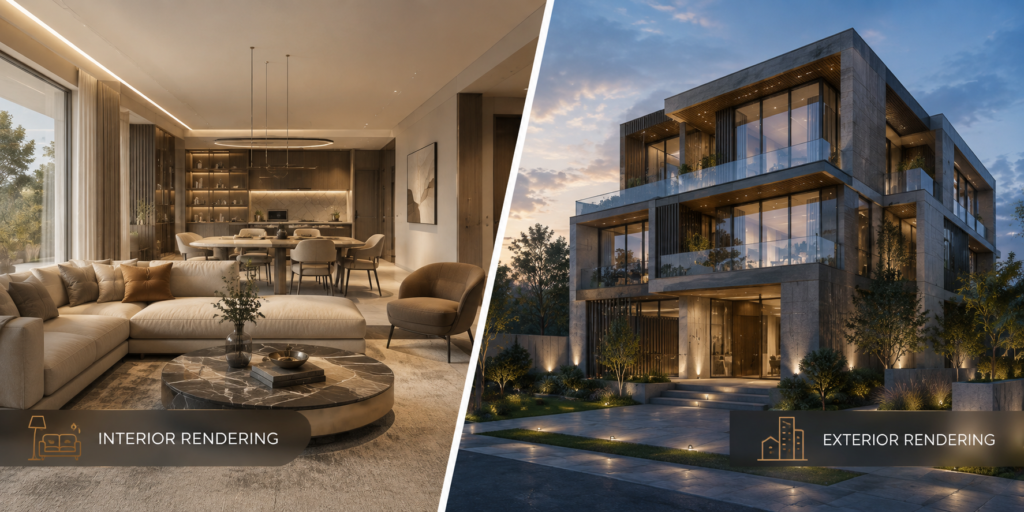
Not all rendering delivers the same kind of return, and this is where a lot of budget gets misallocated. Exterior shots do the heavy lifting early, they’re what appears in ads, on the website, and on outdoor signage, so most developers instinctively prioritize them. But skimping on interiors is a common misstep, because interiors are where buyers form an emotional connection to the actual living experience. Investing properly in 3d interior rendering alongside the exterior work means the buyer’s journey from curiosity to commitment doesn’t hit a wall the moment they start asking about kitchen layouts or ceiling height.
There’s a similar case to be made for exteriors specifically. Comprehensive 3d exterior rendering services aren’t just about one hero shot for the homepage. They cover the range of angles, lighting conditions, and context shots needed across different marketing channels, so the project looks consistent whether someone’s seeing it on a billboard or scrolling past it on their phone.
The Case for Going Beyond Static Images
Static renders answer “what will this look like,” but they don’t fully answer “what will it feel like to be there.” That’s a gap that increasingly matters, especially with buyers who are evaluating a project remotely and may never visit the physical site before making a decision. A well-produced 3d virtual tour rendering fills that gap, letting buyers explore a space at their own pace instead of relying on a handful of curated angles chosen by the marketing team. For developers targeting investors who buy from a distance, this isn’t a nice-to-have. It’s often the deciding factor between a project that gets serious inquiries and one that gets scrolled past.
So, Is It Worth It?
The honest answer is that 3D rendering isn’t an expense to minimize, it’s an investment to allocate correctly. Cutting corners on visualization to save money upfront tends to cost more later, whether that’s in slower sales, weaker buyer confidence, or expensive design corrections after the fact. Developers who treat rendering as part of the sales infrastructure, not an afterthought, consistently see the return show up where it matters most: in how quickly interest turns into signed reservations.