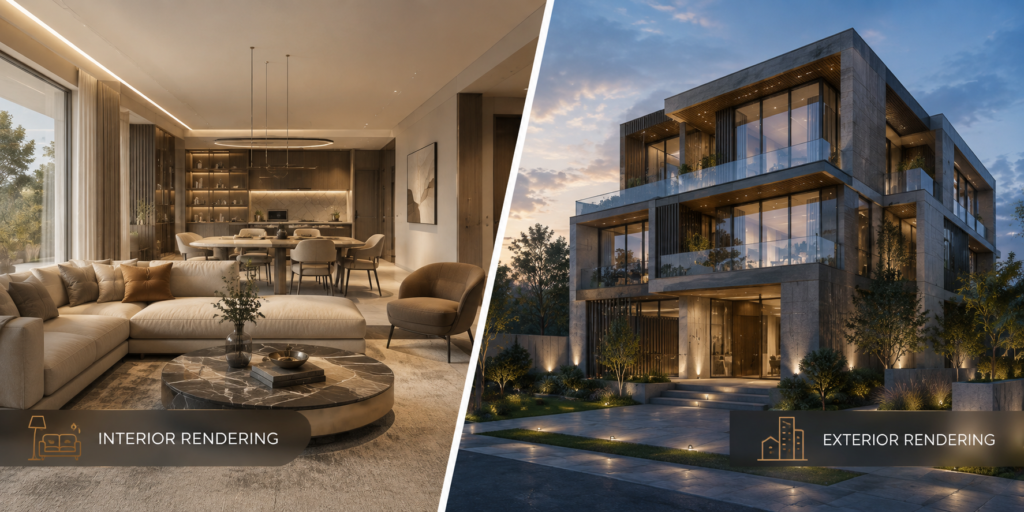

Buying off-plan means committing to something that only exists on paper, or more accurately, in a set of digital files. There’s no hallway to walk through, no kitchen to stand in, no balcony to check the view from. That makes evaluation a very different process than buying a finished, move-in-ready unit. It’s not impossible to make a confident decision before construction starts, but it does require knowing what to actually look for, and where developers tend to cut corners without buyers noticing.
Start With How the Project Is Presented
The first signal worth paying attention to is the quality and depth of the visual materials a developer provides. A project represented only by a few generic-looking images, with no real detail on layouts, finishes, or scale, should raise questions. Developers serious about transparency usually work with an established 3d architectural visualization company to produce visuals that go well beyond a single flattering angle, covering the property from multiple perspectives so buyers get a realistic sense of what they’re actually evaluating, not just a curated highlight reel.
Look Beyond the Unit Itself
A common mistake buyers make is focusing entirely on the interior layout and ignoring everything around it. Before committing, it’s worth understanding how the building sits within its surroundings, how it looks from the street, and how the exterior design holds up from different vantage points. Reviewing detailed 3D exterior rendering services material, covering the facade, entryways, and overall massing, gives a much clearer picture of the finished product than interior shots alone ever could. A property that looks impressive from one hero angle but hasn’t been shown from anywhere else deserves a closer, more skeptical look.
Check How the Space Actually Feels
Layouts on paper can be deceiving. A floor plan might show generous square footage, but without understanding proportion, light, and flow, it’s difficult to judge whether a space will actually feel comfortable to live in. This is where thorough 3D interior visualization becomes useful for evaluation rather than just marketing. Buyers should look for interior visuals that show realistic furniture scale, natural light behavior, and ceiling heights, details that reveal far more about livability than a bare floor plan ever will.
Explore It Yourself, Not Just Through the Developer’s Lens
One of the most useful evaluation tools available to off-plan buyers today is the ability to move through a property virtually, at their own pace, rather than relying entirely on images someone else selected. A well-produced 3D virtual tour rendering
lets a buyer explore room to room, revisit angles that matter to them, and get a genuine sense of spatial flow before making a decision. If a developer can’t or won’t provide this level of access, it’s worth asking why, especially for a purchase of this size.
Motion Reveals What Stills Can Hide
Static images can be composed to hide awkward proportions or less flattering angles. Movement is much harder to manipulate convincingly. Reviewing available 3D cinematic walkthrough footage, if the developer has produced any, offers a continuous, harder-to-fake view of how spaces connect and how light moves through the property across a full sequence rather than a handful of chosen frames. It’s one of the more reliable ways to sanity-check whether the marketing matches what’s likely to actually be built.
Ask What Isn’t Being Shown
Perhaps the simplest evaluation tactic is noticing gaps. If a developer shows beautiful renders of the living room but nothing of the bathrooms, or stunning exteriors but no interior detail at all, that gap is worth investigating directly. Reputable developers generally aren’t afraid to show the full picture because they have nothing to hide. The ones who withhold detail selectively are usually doing so for a reason.
The Bottom Line
Evaluating a property before it’s built comes down to demanding more than a few polished images and a sales pitch. Buyers who look for depth, consistency, and the ability to explore a space on their own terms are far better positioned to make a confident decision, and far less likely to be surprised once the building is finally handed over.