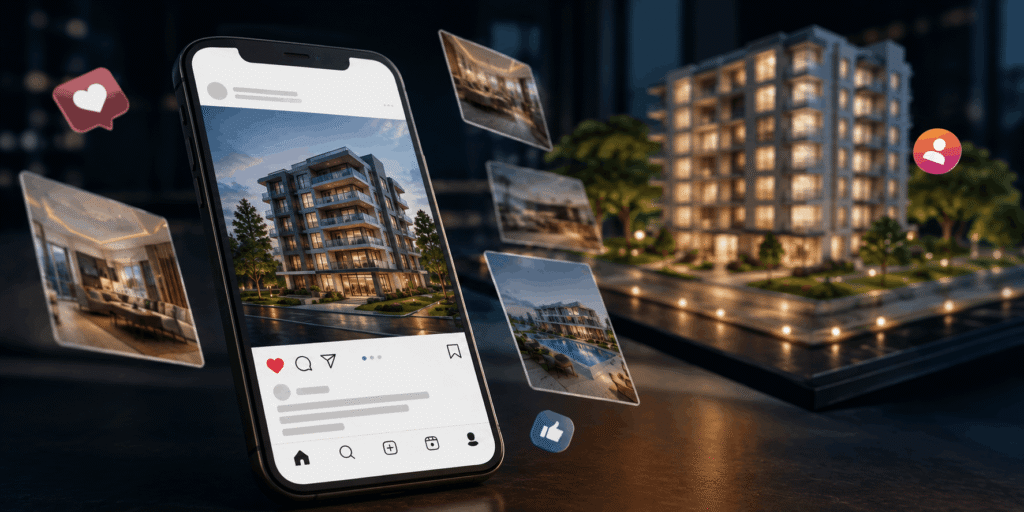
A property launch used to revolve around a sales office, a print brochure, and maybe a billboard on the way into the city. That approach hasn’t disappeared, but it no longer carries the weight it once did. Today, most buyers form their first impression of a project through a phone screen, scrolling past a post between other things, long before they ever consider visiting a sales office or picking up the phone. Social media hasn’t just added another marketing channel to the mix, it’s reshaped the order in which buyers engage with a launch altogether.
Awareness Happens Before Intent
The biggest shift social media has brought to property launches is timing. Buyers used to reach out to a developer once they were already somewhat serious about purchasing. Now, awareness happens much earlier and much more passively, through a video that shows up in someone’s feed, a story shared by a friend, or a post that gets forwarded in a family group chat. This means the content shown at this stage isn’t really trying to close a sale. It’s trying to plant the idea that this project exists and looks worth a second look, well before the buyer has any concrete intention to purchase.
Visual Quality Is the Filter Buyers Apply Instantly
On social platforms, buyers make split-second judgments based almost entirely on visual quality. A blurry photo or a poorly lit render gets scrolled past without a second thought, regardless of how good the actual project is. This puts real pressure on developers to ensure their visual assets hold up in a fast-scrolling environment. Projects backed by a credible architectural visualization studio tend to perform noticeably better here, simply because the content looks professional enough to earn a pause instead of a swipe, which is often the only chance a launch campaign gets to make an impression.
Different Platforms Serve Different Stages
Not all social platforms play the same role in a launch. Some are better suited to building broad initial awareness, quick, visually striking content that reaches people who’ve never heard of the project. Others work better for deeper engagement, longer-form content that lets an already-interested buyer explore further. Understanding this distinction matters for sequencing content properly. A 3D virtual tour rendering, for instance, tends to perform much better on platforms where users are already spending longer, more deliberate time engaging with content, rather than a fast-scrolling feed where it’s likely to be skipped after a second or two.
Consistency Builds the Trust a Launch Depends On
A scattered social presence, inconsistent visuals, mismatched messaging, long gaps between posts, quietly undermines buyer confidence even if no one can pinpoint exactly why. This is especially true in markets where architectural branding in KSA has become a genuine differentiator between developers competing for the same buyer attention. A launch that feels cohesive across every post signals a level of organization and credibility that buyers pick up on instinctively, even if they never articulate it directly.
Social Media Feeds the Rest of the Funnel
Social platforms rarely close a sale on their own, but they play a critical role in feeding everything downstream. A strong social presence generates the inquiries a sales team follows up on, the traffic a website converts into leads, and the retargeting audience that later marketing efforts depend on. Developers who treat social media as disconnected from their broader campaign, rather than working alongside a coordinated real estate digital marketing agency, often end up with strong individual posts that don’t actually translate into a cohesive launch strategy.
Getting the Sequencing Right
The developers who get the most out of social media during a launch treat it as the first step in a longer journey, not a standalone effort. Early content builds broad awareness. Mid-funnel content deepens interest with more detailed visuals. Later content supports the final push toward inquiry and reservation. Skipping straight to hard-sell content without building awareness first usually falls flat, because most of the audience seeing it hasn’t been given a reason to care yet.
The Bottom Line
Social media has become the entry point for most property launches, whether developers plan for it deliberately or not. Getting it right isn’t about posting more, it’s about sequencing the right content at the right stage, backed by visuals strong enough to earn attention in an environment built for scrolling past almost everything.